Cutting Back on Salt: A Realistic Guide to Eating Less Sodium
Salt is one of the few nutrients most of us eat far too much of without ever reaching for the salt shaker. The good news is that cutting back is less about willpower and more about knowing where sodium hides — and giving your taste buds a few weeks to adjust.
- The WHO recommends less than 5 g of salt a day; the UK limit for adults is 6 g.
- Around three quarters of the salt we eat is already in food when we buy it.
- To turn sodium into salt, multiply by 2.5.
- Cut back gradually — taste preferences adapt within weeks.
Why salt matters
Salt (sodium chloride) is not a villain. Your body needs sodium to keep fluids balanced, to send nerve signals and to contract muscles. The problem is dose. When intake stays high for years, it is linked to raised blood pressure, and high blood pressure is one of the leading risk factors for heart disease and stroke worldwide. The World Health Organization estimates that excess sodium intake is associated with millions of deaths each year, which is why reducing salt is one of its most frequently recommended public health measures.
Not everyone responds to salt in the same way. Some people are more "salt sensitive" than others — their blood pressure rises more when they eat more salt. Older adults, people with existing high blood pressure and people with kidney disease tend to be more sensitive. Because you can't easily tell whether you are one of them, general guidance applies to everyone.
How much is too much?
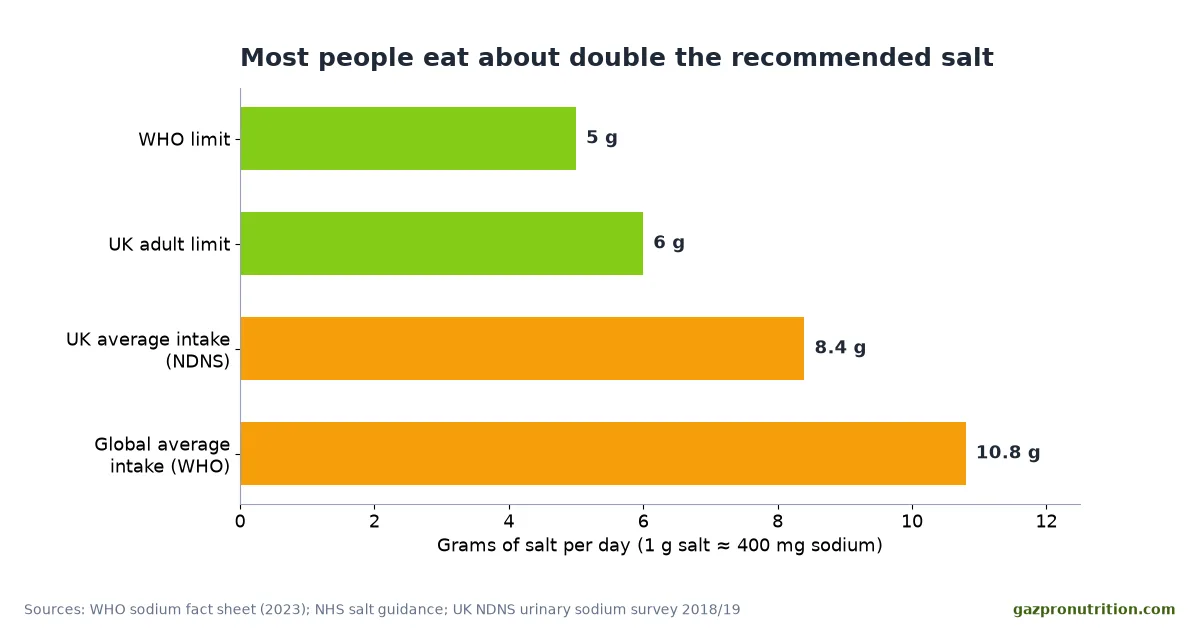
The WHO recommends that adults eat less than 5 g of salt per day, which is just under a level teaspoon and equals about 2 g of sodium. UK guidance is a little more lenient at a maximum of 6 g of salt a day for adults, with lower limits for children. Real-world intake is well above both. The WHO's 2023 global report put average adult intake at around 10.8 g of salt per day, and the most recent urinary sodium survey for adults in England estimated about 8.4 g per day.
Where the salt in your diet really comes from
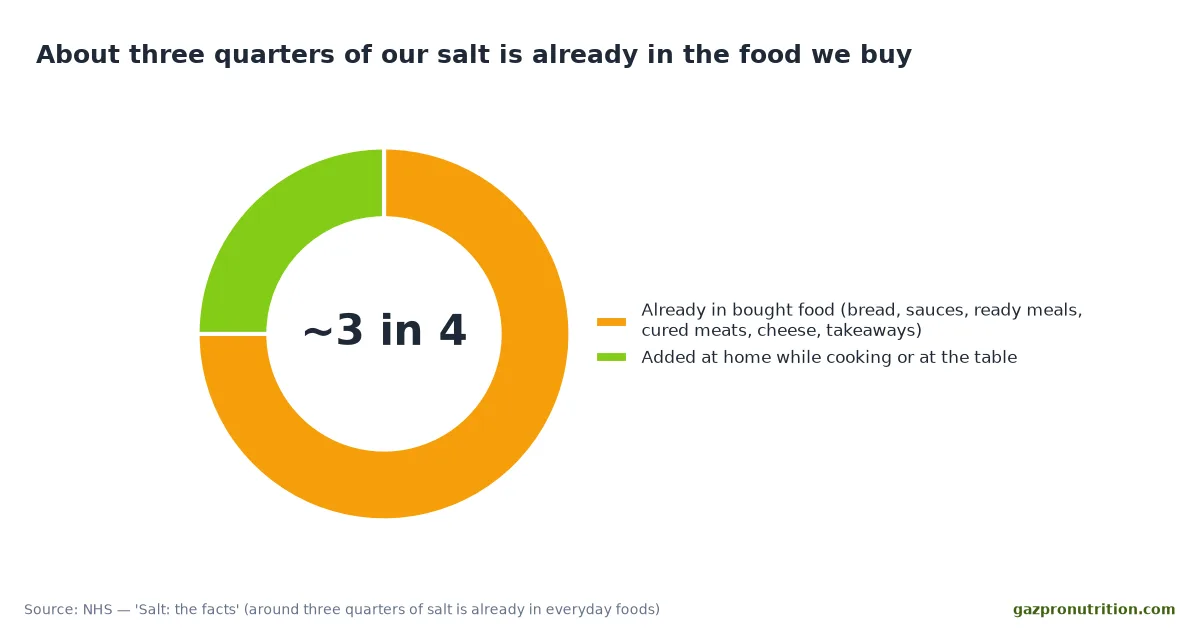
If you rarely add salt at the table, it is easy to assume your intake is low. But according to the NHS, around three quarters of the salt we eat is already in everyday foods such as bread, breakfast cereals, sauces, ready meals, processed meats and cheese. Restaurant and takeaway meals are also major contributors, because salt is a cheap way to boost flavour.
Some of the biggest sources are not foods that taste especially salty. Bread is a good example: a single slice doesn't contain much, but because many people eat several slices a day, it adds up. The same goes for breakfast cereals and sweet biscuits. Foods that combine several salty ingredients — a pizza with cured meat and cheese, or a sandwich with ham, cheese and pickles — can supply a large share of your daily limit in one go.
| Food group | Why it adds up | Easy switch |
|---|---|---|
| Bread and rolls | Moderate salt, eaten several times a day | Compare brands; some contain noticeably less salt |
| Processed meats (ham, bacon, salami) | Salt is used for curing and preserving | Use fresh chicken, eggs, beans or fish as sandwich fillings |
| Cheese | Salt is part of cheese-making | Use a smaller amount of a strongly flavoured cheese |
| Sauces, stock cubes and gravy | Very concentrated sources | Use low-salt stock, or build flavour with herbs, garlic and citrus |
| Ready meals and takeaways | Large portions, several salty components | Check the label; balance with a lower-salt meal the same day |
| Crisps and salted nuts | Surface salt is tasted immediately | Choose unsalted nuts or plain popcorn |
How to read salt on a food label
Labels can list either salt or sodium, which causes a lot of confusion. The conversion is simple: salt = sodium × 2.5. So a product with 600 mg of sodium per serving contains about 1.5 g of salt. In the UK and EU, labels usually show salt directly; in the US, the Nutrition Facts label shows sodium in milligrams along with a % Daily Value.
In the UK, front-of-pack traffic-light labels give a quick guide. Per 100 g, a food is considered high in salt above 1.5 g (red) and low at 0.3 g or less (green). In the US, the FDA suggests that 5% Daily Value or less of sodium per serving is low and 20% or more is high. Whichever system you use, always check the serving size — many people eat more than one "serving" of foods such as soup, noodles or crisps.
A tin of soup lists 0.9 g of sodium per 100 g, and the whole 400 g tin is one meal. That is 3.6 g of sodium per tin — multiply by 2.5 and you get 9 g of salt, more than the full daily limit. A lower-salt version at 0.25 g sodium per 100 g comes to about 2.5 g of salt for the tin.
A four-week plan to cut back
Trying to go from a high-salt diet to very little salt overnight usually fails, because food suddenly tastes flat. A gradual approach works better. Taste receptors adapt: after a few weeks of eating less salt, many people find their old favourites taste too salty.
- Week 1 — Find your top three sources. Look at the labels of the foods you eat most often. Most people discover that two or three items (often bread, a sauce and a processed meat) supply a large share of their salt.
- Week 2 — Swap one staple. Replace one of those items with a lower-salt version or an alternative. Keep everything else the same.
- Week 3 — Cook with less. Halve the salt you add while cooking, and taste before adding more at the table. Take the salt shaker off the table if it's an automatic habit.
- Week 4 — Build flavour differently. Use garlic, onion, chilli, fresh herbs, spices, black pepper, lemon or lime juice and vinegar. Roasting and browning also add depth of flavour without salt.
Flavour without salt: what actually works
Acidity is one of the best substitutes, because it brightens food in a similar way to salt. A squeeze of lemon over grilled fish or a splash of vinegar in a stew can make you miss the salt far less. Aromatic ingredients such as garlic, ginger, spring onions and fresh herbs add complexity. Spices such as cumin, smoked paprika and coriander give savoury depth. Ingredients naturally rich in umami — tomatoes, mushrooms and a little parmesan — can also make dishes taste more satisfying, although cheese and soy sauce themselves contain salt, so use them sparingly.
Be cautious with "salt substitutes" that replace sodium with potassium chloride. They can help some people reduce sodium, but they are not suitable for everyone — especially people with kidney disease or those taking certain blood pressure medicines — so check with a doctor or pharmacist first.
The other half of the story: potassium
Blood pressure is influenced by the balance between sodium and potassium, not sodium alone. Potassium is found in fruit, vegetables, beans, lentils, nuts, dairy and fish. The DASH eating plan, developed and tested in US clinical trials, combined lower sodium with plenty of these foods and lowered blood pressure in many participants. In practice, the same changes that reduce salt — cooking more from scratch and eating more whole foods — also tend to raise potassium.
Common salt myths
"Sea salt and pink salt are healthier." They may contain trace minerals and have larger crystals, but gram for gram they are still almost entirely sodium chloride. They count the same towards your daily limit.
"I don't add salt, so I'm fine." Because most salt is already in the food we buy, you can easily exceed the limit without ever using a salt shaker.
"I sweat a lot, so I need more salt." People doing long, intense exercise in the heat may lose significant sodium in sweat, and for them sodium replacement can matter. For most people doing everyday activity, typical diets already provide more than enough. Our guide to electrolytes covers when extra sodium makes sense.
Salt when eating out
Restaurant and takeaway dishes are often among the saltiest meals of the week. You don't need to avoid them, but a few habits help: ask for sauces and dressings on the side, choose grilled or steamed dishes over those with rich sauces, share salty sides, and balance a salty meal with lower-salt food the rest of the day. Our guide to eating out healthily has more practical ideas.
When to talk to a professional
If you have high blood pressure, heart failure or kidney disease, your doctor may recommend a specific sodium target that differs from general advice. Some medicines also interact with sodium or potassium intake. In those cases, personalised advice from a doctor or registered dietitian is the right next step.
Frequently asked questions
How much salt should an adult eat per day?
The WHO recommends less than 5 g of salt a day (under 2 g of sodium), and UK guidance sets a maximum of 6 g for adults. Most adults eat noticeably more than either figure.
How do I convert sodium to salt?
Multiply the sodium figure by 2.5. For example, 400 mg of sodium is about 1 g of salt.
Is sea salt or pink salt healthier than table salt?
Not meaningfully. Gram for gram they are almost entirely sodium chloride, so they count the same towards your daily limit.
How long does it take to get used to less salt?
Many people find food tastes normal again after a few weeks of gradually reducing salt, as taste preferences adjust.
References
This article is general information and not a substitute for personalised advice from a doctor or registered dietitian. Charts and graphics on this page were created by Gazpro Nutrition from the sources listed; the lead photo is a real photograph licensed from Burst by Shopify and credited beneath the image. Spotted an error? See our corrections policy.